What’s Modern Strategic Management!
Some organizations survive by following plans.
The truly enduring ones survive by listening — learning — adapting — before the world demands it.
Once, strategy meant a five-year plan with milestones, forecasts, and rigid structures. It gave comfort but not always survival. Today, markets reshape overnight, citizens demand agility, and technology redraws industries faster than annual planning cycles can respond.
The question is no longer “What is our strategy?”
It is “How alive is our strategy?”
The Limits of Yesterday’s Tools
Classic strategy tools — Porter’s Five Forces, SWOT, BCG, IFE/EFE, and QSPM — gave decades of guidance. They structured thought, created discipline, and offered a sense of control. But in today’s environment, their rigidity is a liability.
- Static assumptions: Traditional matrices assume stability, but markets now shift faster than analyses can be updated.
- Linear processes: Formulation → Implementation → Evaluation works in theory, but real change is rarely linear.
- Time-intensive calculation: Weighted scoring systems and exhaustive audits delay decision-making.
Real-world evidence:
Nokia’s inability to adapt quickly to smartphone innovation illustrates how planning excellence cannot substitute for sensing and agility. Similarly, many government 5-year plans lagged behind citizen expectations because they were too rigid to incorporate real-time feedback.
These tools are not wrong — they are incomplete. Their spirit remains, but modern strategic practice treats them as reference points, not mandates.
Strategy as Motion: From Plan to System
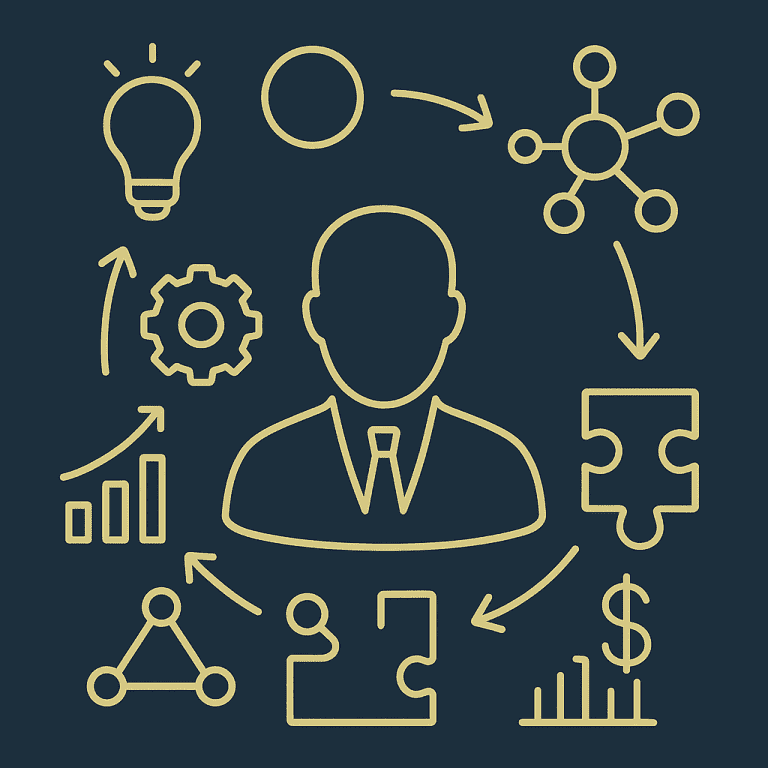
Modern organizations treat strategy not as a document but as a living system. The model is circular, not linear:
Sense → Decide → Act → Learn → Sense again
This approach integrates:
- Continuous environmental scanning to detect emerging trends.
- Rapid hypothesis testing to validate strategic choices.
- Real-time adaptation to correct course before crises appear.
This shift is reflected in frameworks like:
- Mintzberg’s Emergent Strategy: Strategy as patterns in action, not solely planned intentions.
- McKinsey’s Strategy as a Journey: Strategy as a perpetual cycle of sensing, prioritizing, testing, scaling, and learning.
- Dynamic Capabilities (Teece): Ability to sense opportunities, seize them quickly, and reconfigure organizational assets.
In practice, the organization becomes a living organism, capable of learning faster than the environment changes. For GCC public-sector leaders, this means adaptive policymaking, citizen-centered innovation, and continuous service redesign.
The New Toolkit of Strategic Management
Modern strategy embraces frameworks and tools that support continuous learning, fast decision-making, and adaptability.
| Framework / Tool | What It Is | Why It Matters / Obsolete Alternative |
|---|---|---|
| OKRs (Objectives & Key Results) | Aligns teams around measurable, short-term outcomes. | Replaces static annual KPIs or QSPM scoring. |
| Agile Strategy & Continuous Planning | Strategy updated dynamically with feedback loops. | Replaces rigid 3–5 year plans. |
| Strategy Sprints | Short, cross-functional workshops to co-create strategy. | Replaces top-down retreats and consultant-led sessions. |
| Business Model Canvas | Visual map of value proposition, channels, revenue, and partners. | Replaces lengthy linear business plans. |
| Lean Startup / Build–Measure–Learn Loop | Rapid experimentation to validate assumptions. | Replaces heavy upfront analyses (IFE/EFE, SWOT). |
| Systems Mapping & Causal Loops | Visualizes dynamics, feedback, and leverage points. | Updates static SWOT or value-chain thinking. |
| Scenario Planning (Modern Shell Style) | Explores multiple futures and stress-tests decisions. | Replaces linear forecasting models. |
| Design Thinking & Human-Centered Strategy | Empathy-driven problem-solving and co-creation. | Counters inward, analytical-only planning. |
| Ecosystem Strategy | Designs adaptive partnerships and shared-value platforms. | Replaces industry boundary mindset from Porter. |
| AI-Augmented Strategy Tools | Uses ML and analytics for trend detection, simulation, and risk mapping. | Replaces manual EFE/QSPM analyses. |
| McKinsey’s 3 Horizons | Balances current optimization with growth and future bets. | Evolves one-dimensional growth plans. |
Blurring the Lines of Advantage
Treacy and Wiersema’s Value Disciplines — Operational Excellence, Product Leadership, Customer Intimacy — still guide organizations.
But in practice, boundaries blur:
- Amazon combines operational efficiency and personalized experience.
- Tesla blends product innovation with cost mastery.
- Four Seasons integrates intimate, personalized service with operational excellence.
- Dubai Government fuses citizen-centric digital services with streamlined delivery.
The lesson: prioritize one anchor discipline, but deliberately blend others to create integrated, adaptive advantage.
Where the Old Tools Still Whisper
Not all classic tools are obsolete — they can be repurposed:
- Porter’s Five Forces → as “ecosystem tension map” rather than predictive certainty.
- SWOT → as an evolving learning map, updated quarterly.
- BCG → as visual investment tempo, not precise growth predictor.
The key is agility: keep the insight, discard the rigidity.
The Practice of a Modern Strategist
- Anchor to Purpose: Define a North Star that remains constant amid flux.
- Translate Into Experiments: Break large initiatives into pilots.
- Align Around Outcomes: Use OKRs or KPIs linked to learning.
- Build Dynamic Capabilities: Invest in talent, technology, and cross-functional agility.
- Institutionalize Reflection: Schedule regular strategy reviews, not just crisis check-ins.
Strategy becomes less about predicting the future and more about building the capacity to adapt to it.
Endurance in Motion
There is a paradox at the heart of modern strategy:
To remain stable, an organization must embrace change.
To endure, it must learn continuously.
The companies and institutions that survive are not those with perfect plans,
but those whose strategy breathes — sensing, adapting, and transforming in real time.
Strategy today is no longer a document to file away.
It is a living capability,
and the organizations that master it will define the next generation of leadership.
- When Strategy Learns to Breathe: The New Art of Modern Strategic Management